As AI computing, 5G-A, and 400G/800G network upgrades accelerate, high-density, high-speed optical interconnection has become the core demand of data centers, enterprise networks, and telecom infrastructure. Among all fiber interconnection solutions, MPO (Multi-Fiber Push-On) fiber patch cords stand out for their compact design and parallel transmission capabilities—especially 12-core and 24-core MPO jumpers, which are the most widely used specifications in today’s high-speed network deployments <superscript:3>. At Mars Optical (www.marsoptical.com), we often help customers choose between 12-core and 24-core MPO jumpers based on their project needs. Today, we’ll break down their core features, key differences, application scenarios, and selection tips to help you make the right decision.
What Are 12-Core & 24-Core MPO Fiber Patch Cords?
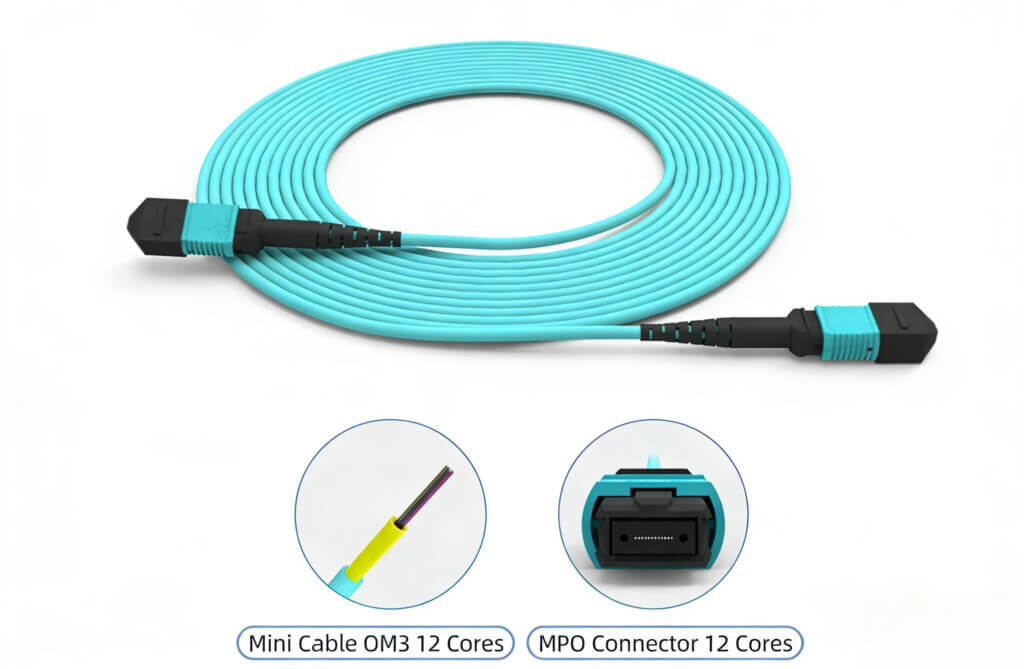
MPO fiber patch cords are high-density multi-core optical cables that integrate multiple fiber cores into a single rectangular connector, using precision MT ferrules and guide pins to achieve micron-level alignment<superscript:1>. Both 12-core and 24-core MPO jumpers adopt this core design, but they differ in fiber core count, transmission capacity, and application positioning—making them suitable for distinct network scenarios.
1. 12-Core MPO Fiber Patch Cords: The “All-Rounder” for Mid-Speed Networks
12-core MPO jumpers integrate 12 fiber cores into one connector, with a compact 6mm diameter design that saves significant cabinet space compared to traditional single-core LC patch cords <superscript:1>. They are designed for mid-speed, medium-density network scenarios, supporting transmission rates of 40G/100G, and are widely recognized as the “most versatile” MPO specification, accounting for 65% of the MPO market share.
Key features of 12-core MPO jumpers include: low insertion loss (≤0.3dB), high return loss (≥58dB), support for Type A/B/C polarity, and compatibility with mainstream QSFP28 optical transceivers<superscript:2>. They typically use 8 of the 12 cores for 40G/100G transmission, with 4 cores reserved for future expansion, balancing cost and flexibility.
2. 24-Core MPO Fiber Patch Cords: The “Powerhouse” for High-Density, High-Speed Networks
24-core MPO jumpers integrate 24 fiber cores (arranged in two rows of 12) into a single connector, doubling the core density of 12-core models <superscript:7>. As the core component of 400G/800G networks and AI data centers, they are designed to meet the explosive demand for high-bandwidth, high-density interconnection driven by AI computing and CPO (Co-Packaged Optics) technology.
Key features of 24-core MPO jumpers include: ultra-high density, support for 100G/400G/800G transmission rates, IP67 waterproof protection (for industrial scenarios), and compatibility with QSFP-DD/OSFP optical transceivers <superscript:3>. They use 20 of the 24 cores for 100G full-duplex transmission, with 4 cores reserved for redundancy, ensuring stable and reliable signal transmission in high-load environments .
Key Differences Between 12-Core & 24-Core MPO Jumpers
To help you quickly distinguish between the two specifications, we’ve summarized their core differences in a detailed table—covering core count, transmission capacity, cost, and more, so you can match them to your project needs at a glance:
| Comparison Dimension | 12-Core MPO Fiber Patch Cord | 24-Core MPO Fiber Patch Cord |
|---|---|---|
| Fiber Core Count | 12 cores (single row) | 24 cores (two rows of 12) |
| Max Transmission Rate | 40G/100G (uses 8 cores, 4 reserved) | 100G/400G/800G (uses 20 cores, 4 reserved) |
| Density & Space Saving | Saves 70% cabinet space vs single-core LC jumpers <superscript:1> | Saves 80%+ cabinet space vs single-core LC jumpers; 50% less space than 12-core models <superscript:6> |
| Core Function & Redundancy | Basic parallel transmission; 4 reserved cores for future expansion | High-speed parallel transmission; 4 reserved cores for redundancy and maintenance |
| Cost & Cost-Efficiency | Lower unit price (cost-effective for medium-scale projects) | Higher unit price; lower unit core cost for large-scale deployments <superscript:3> |
| Optical Transceiver Compatibility | Compatible with QSFP28 (100G) optical transceivers <superscript:4> | Compatible with QSFP-DD/OSFP (400G/800G) optical transceivers <superscript:3> |
| Installation Complexity | Simple, plug-and-play; suitable for on-site deployment by non-professionals | Medium; requires professional operation for polarity management and end-face cleaning <superscript:4> |
Application Scenarios: Choose 12-Core or 24-Core?
The choice between 12-core and 24-core MPO jumpers depends on your network speed, fiber density, and future expansion needs. Below are their typical application scenarios to help you make a quick and accurate decision:
Choose 12-Core MPO Jumpers If:
- Your network is running at 40G/100G, such as enterprise core networks, small-to-medium data centers, and 5G fronthaul.
- You need a cost-effective solution with medium density—e.g., connecting switches to servers in small data centers or office buildings.
- You have limited cabinet space but don’t require ultra-high density (e.g., retail stores, small office networks, or surveillance systems)
- You need flexible expansion—12-core jumpers reserve 4 cores, allowing you to upgrade your network without replacing the entire cable.
Choose 24-Core MPO Jumpers If:
- Your network is upgrading to 400G/800G, such as hyperscale AI data centers, HPC (High-Performance Computing) clusters, and CPO-equipped servers <superscript:3>.
- You need high-density interconnection—e.g., data center backbone networks, switch-to-switch connections, or AI server clusters with massive data transmission needs <superscript:6>.
- You prioritize long-term scalability—24-core jumpers support smooth upgrades to 1.6T networks, protecting your initial investment <superscript:3>.
- You need reliable redundancy—e.g., telecom central offices, backbone networks, or critical industrial networks that require 99.999% uptime <superscript:6>.
Choose 24-Core MPO Jumpers If:
- Your network is upgrading to 400G/800G, such as hyperscale AI data centers, HPC (High-Performance Computing) clusters, and CPO-equipped servers <superscript:3>.
- You need high-density interconnection—e.g., data center backbone networks, switch-to-switch connections, or AI server clusters with massive data transmission needs <superscript:6>.
- You prioritize long-term scalability—24-core jumpers support smooth upgrades to 1.6T networks, protecting your initial investment <superscript:3>.
- You need reliable redundancy—e.g., telecom central offices, backbone networks, or critical industrial networks that require 99.999% uptime <superscript:6>.