In the era of 5G, AI, and cloud computing, fiber optic networks have become the backbone of digital transformation, connecting everything from data centers to smart homes. Two essential components that ensure stable, efficient fiber connection and management are Fiber Terminal Box and ODF (Optical Distribution Frame). While both are used for fiber termination, protection, and connection, they serve distinct roles in different network scenarios. At Mars Optical (www.marsoptical.com), we often help customers distinguish between these two devices to choose the optimal solution for their projects. Today, we’ll break down their key differences, applications, and selection tips.
What Are Fiber Terminal Box and ODF?
Before diving into the differences, let’s clarify the core definitions of these two essential fiber components—both are designed to protect fiber connections and ensure signal stability, but their positioning and capabilities vary significantly.
ODF (Optical Distribution Frame): The “Central Dispatching Hub” of Fiber Networks
ODF, short for Optical Distribution Frame, is a standardized, high-density device used for centralized management and flexible dispatching of large-scale fiber links. It serves as the “nerve center” of fiber networks, responsible for splicing, terminating, distributing, and dispatching main fiber cables, branch fibers, and fiber jumpers
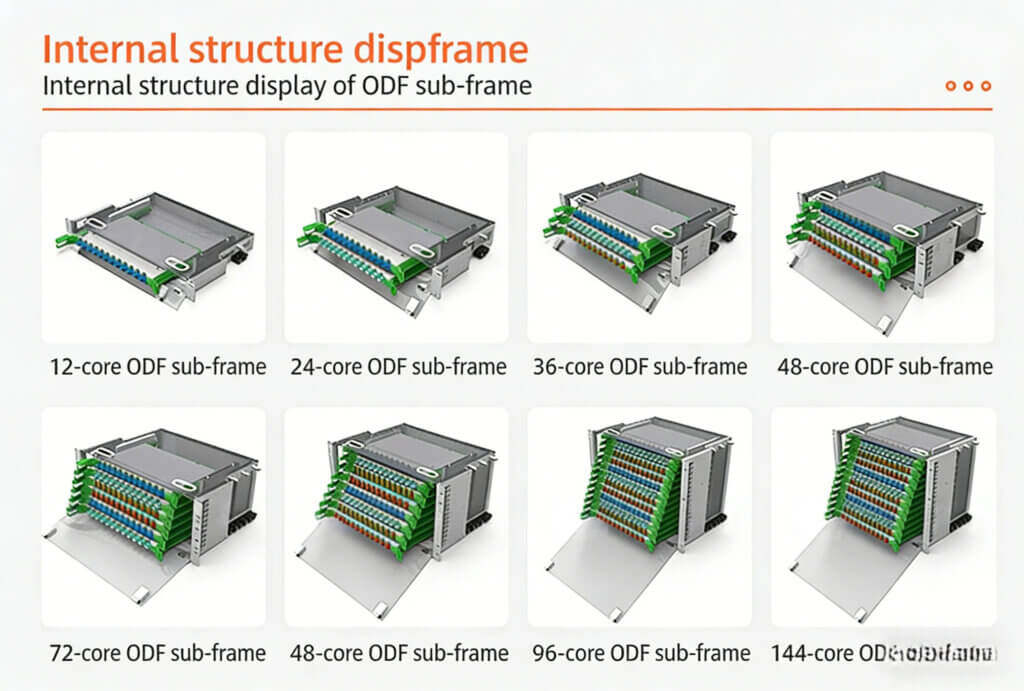
Designed for 19-inch standard cabinets, ODFs have a complex structure with integrated components such as splicing trays, coupler panels, cable management devices, identification labels, and grounding devices <superscript:1>. They support high-capacity fiber deployment and flexible jumper cross-connection, making them suitable for large-scale network scenarios that require frequent maintenance and expansion.
Key Differences Between Fiber Terminal Box and ODF
To help you quickly distinguish between the two, we’ve summarized their core differences in structure, function, capacity, and application scenarios in the table below—this will help you make the right choice for your project:
| Comparison Dimension | Fiber Terminal Box | ODF (Optical Distribution Frame) |
|---|---|---|
| Structure & Design | Compact, wall-mounted/desktop/embedded; simple structure, no independent cable management <superscript:1> | Rack-mounted (19-inch standard), large size; complex structure with complete cable management and grounding <superscript:5> |
| Capacity | Small-capacity: 4/6/8/12 cores; fixed capacity, no expansion space <superscript:1> | High-density: 12/24/48/72/144/288 cores; support expansion by adding splicing trays <superscript:5> |
| Core Function | Terminal splicing + fiber protection; no dispatching function; fixed connection after splicing <superscript:1> | Centralized management + flexible dispatching; splicing, termination, cross-connection, and fault switching <superscript:3> |
| Operation & Maintenance | Fixed after splicing; no frequent jumper insertion/removal; maintenance requires re-splicing <superscript:1> | Supports frequent jumper insertion/removal; easy maintenance, expansion, and link adjustment<superscript:1> |
| Material & Protection | ABS engineering plastic or thin steel; medium protection level, suitable for indoor use<superscript:1> | Cold-rolled steel with spray coating; high dust-proof and anti-impact performance; suitable for machine room environments <superscript:5> |
| Cost | Low unit price (tens to hundreds of USD); high unit core cost for large-scale use<superscript:1> | High unit price (hundreds to thousands of USD); low unit core cost for large-scale use <superscript:1> |
Application Scenarios: When to Choose Which?
The choice between Fiber Terminal Box and ODF depends primarily on your project’s fiber capacity, deployment location, and management needs. Below are their typical application scenarios to help you make a quick decision:
Fiber Terminal Box: Ideal for Edge & Small-Capacity Scenarios
Fiber Terminal Boxes are perfect for network edge points where fiber capacity is small and no flexible dispatching is needed. Common application scenarios include<superscript:1><superscript:2>:
- FTTH (Fiber to the Home) and FTTB (Fiber to the Building) projects: Terminating fiber cables at home entrances or building weak current wells.
- Small offices and retail stores: Connecting main fiber cables to switches or ONUs for small-scale network access.
- Security monitoring points: Terminating fiber cables near surveillance cameras to protect connections and引出 interfaces.
- Outdoor small base stations and temporary wiring projects: Simple protection for fiber termination in harsh environments (with outdoor-rated models).
ODF: Ideal for Core & Large-Scale Scenarios
ODFs are designed for core network nodes where large-scale fiber management and flexible dispatching are required. Common application scenarios include <superscript:3><superscript:5>:
- Data centers and enterprise core machine rooms: Centralizing management of hundreds of core main fiber cables and realizing flexible link dispatching between servers and switches.
- Telecom operator central offices and backbone network nodes: Connecting and dispatching main fiber cables for urban and regional fiber networks.
- Large-scale smart parks and industrial parks: Managing fiber links between buildings and realizing cross-connection of different functional areas.
- High-performance computing (HPC) and AI clusters: Supporting high-density fiber deployment and stable signal transmission for high-speed networks.
Choose Fiber Terminal Box If:
- Your project has small fiber capacity (≤12 cores) and no need for flexible dispatching.
- You need a compact, easy-to-install device (e.g., wall-mounted in small offices or monitoring points).
- Your budget is limited, and you need a cost-effective solution for edge network access.
Choose ODF If:
You require flexible link dispatching and frequent maintenance (e.g., data center server connections).
Your project requires large-capacity fiber management (≥24 cores) or future expansion.
You need centralized management of fiber links (e.g., data centers, telecom backbone networks).
Mars Optical’s Solutions
At Mars Optical (www.marsoptical.com), we offer a full range of fiber terminal boxes and ODF products to meet diverse project needs:
- Fiber Terminal Box: 4-12 core, indoor/outdoor models, IP67 waterproof, compatible with various fiber types.
- ODF: 12-288 core high-density designs, 19-inch rack-mounted, with complete cable management and grounding systems.
- Customization: OEM/ODM services available, including capacity, material, and interface customization.
All our products undergo strict quality testing to ensure stable performance and long service life. Whether you need a compact fiber terminal box for edge access or a high-density ODF for data centers, we can provide tailored solutions.