
As we enter March 2016, the global fiber optic network industry is accelerating its transition toward intelligence and modularization—driven by the continuous expansion of FTTH projects, the rapid growth of data centers, and the rising demand for efficient fiber management in emerging scenarios like smart cities and industrial internet. According to industry data, China’s ODF (Optical Distribution Frame) market size has reached approximately 15 billion RMB in 2016, with a year-on-year growth rate exceeding 10%, as ODF frames evolve from basic fiber management devices to intelligent, scalable core components. With Huawei’s recent breakthroughs in intelligent ODN (iODN) systems and the widespread adoption of modular ODF designs, 2016 is proving to be a year of innovation for ODF technology. Today, we’ll explore the 2016 ODF market landscape, key trends, application expansions, and how to choose the right ODF frame for your 2016 network projects.
What Is an ODF Frame? 2016’s Evolving Core of Fiber Management
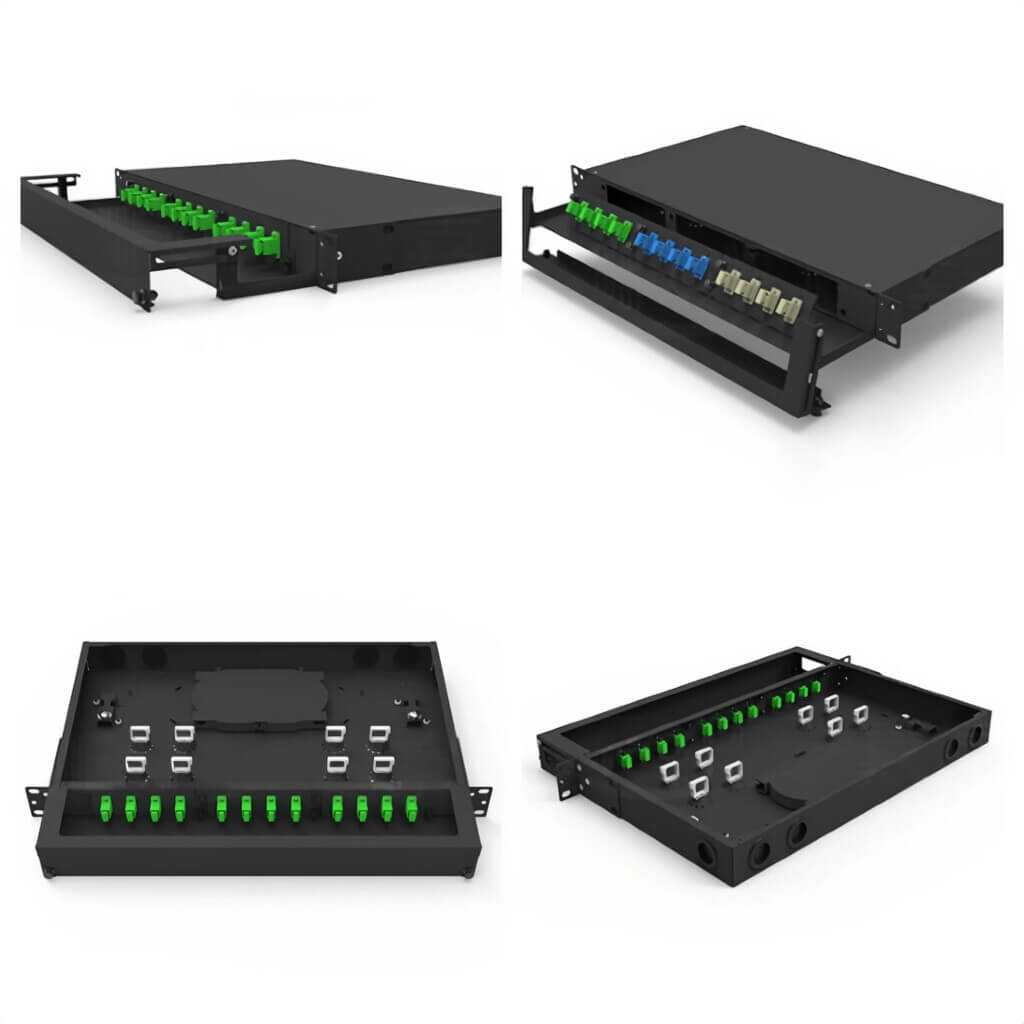
An ODF (Optical Distribution Frame) remains the “nerve center” of fiber optic networks in 2016—integrating fiber splicing, termination, distribution, and protection into a standardized, rack-mounted or wall-mounted device. Serving as the critical link between backbone fiber cables and end-user devices, ODF frames ensure orderly fiber routing, stable signal transmission, and easy maintenance—essential for modern high-density fiber networks.
By March 2016, ODF technology has advanced significantly from 2015, with three key upgrades defining the market: intelligence, modularization, and miniaturization. Building on the foundation of international standards like IEC 61754-7 and TIA/EIA-568-C.3, 2016 ODF frames now widely adopt modular designs that allow flexible capacity expansion, while intelligent models integrate electronic tags (EID), on-site assistance tools, and network management systems (NMS) to automate data collection and reduce human error.
The most common ODF configurations in March 2016 include 12-core, 24-core, 48-core, and 72-core models, with 48-core rack-mounted ODFs leading the market for large-scale scenarios (central offices, data centers) and 12/24-core wall-mounted ODFs gaining traction for small-scale, space-constrained applications like smart city monitoring points and industrial sensor connections. Notably, Huawei’s iODN system—first launched in 2010 and upgraded in 2016—has become a benchmark for intelligent ODF deployment, helping operators like Shaanxi Mobile (a subsidiary of China Mobile) eliminate manual management inefficiencies.
2016’s Key ODF Trends: Intelligence, Modularity & Expanded Applications
March 2016 marks a turning point for ODF frames, as three core trends reshape the market—driven by demand from telecom operators, data centers, and emerging industries like smart cities and industrial internet. These trends are making ODF frames more versatile, efficient, and adaptable to diverse network needs:
1. Intelligent ODF (iODF) Enters Large-Scale Pilot Phase
In 2016, intelligent ODF frames are no longer in the experimental stage—telecom operators across Asia are deploying iODF systems to replace manual fiber management. Shaanxi Mobile’s 2016 iODF deployment is a prime example: by upgrading traditional ODFs to intelligent models with EID chips and NMS integration, the operator reduced work order processing time from 20 days to a few hours and eliminated data entry error rates (previously 30%). Huawei’s iODN solution, which includes adjustable telescopic clasps to fit different-sized ODF arrays, has enabled seamless upgrades without service interruptions—setting a new standard for intelligent fiber management.
Key features of 2016 intelligent ODF frames include real-time port status monitoring, automatic connectivity data collection, and remote fault diagnosis—all designed to boost O&M efficiency by 60% or more. While iODF still accounts for a small share of the total ODF market in March 2016, industry experts predict it will capture 25% of the market by 2023.
2. Modular & Miniaturized Designs for Diverse Scenarios
2016 sees a surge in demand for modular ODF frames, which allow operators to expand fiber capacity incrementally (adding 12-24 cores at a time) without replacing the entire frame—reducing costs and improving scalability. This design is particularly popular in data centers and enterprise networks, where fiber demand grows dynamically.
Miniaturization is another key trend: wall-mounted ODF frames (12-core and 24-core) are increasingly used in smart cities, industrial internet, and FTTH distribution points. These compact models are designed to fit small spaces (e.g., building weak current wells, industrial control cabinets) and often feature IP65/IP67 waterproof protection for harsh outdoor or industrial environments. The global wall-mounted ODF market is expected to grow steadily, driven by smart city and industrial 4.0 initiatives.
3. Market Expansion & Intensified Competition
By March 2016, the global ODF market is expanding rapidly, with China leading growth—its market size reaching 15 billion RMB and expected to climb to 25 billion RMB by 2020. This growth has attracted intense competition, with top manufacturers (Huawei, ZTE, Fiberhome) and emerging players vying for market share. Competition has driven technological innovation and cost optimization: 2016 ODF frames are 10-15% more cost-effective than 2015 models, while offering better performance and compatibility.
Notably, single-mode ODF frames dominate the 2016 market (accounting for over 60%) due to their long transmission distance and high bandwidth, making them ideal for telecom backbones and data centers. Multi-mode ODFs, however, remain popular for short-distance applications like enterprise campus networks.
2016 ODF Frame Applications: Beyond Telecom & Data Centers
In March 2016, ODF frames are no longer limited to traditional telecom and data center scenarios—they are expanding into emerging industries, driven by the growth of smart cities, industrial internet, and renewable energy. Here are the key application areas shaping the 2016 ODF market:
1. Telecom Networks & FTTH Deployment
Telecom operators remain the largest ODF adopters in 2016, using 48-core and 72-core rack-mounted ODFs in central offices and 12/24-core wall-mounted ODFs in FTTH distribution points. With global FTTH coverage continuing to expand, ODF frames play a critical role in connecting backbone fibers to individual households—ensuring efficient fiber management and reliable service.
2. Data Centers & Cloud Infrastructure
Data centers account for over 40% of ODF demand in 2016, as cloud computing and big data drive the need for high-density fiber management. 48-core and 96-core modular ODF frames are widely used to connect servers, switches, and storage devices—saving cabinet space and supporting flexible capacity expansion. As data centers grow in size, ODF frames with low insertion loss and easy maintenance become increasingly critical.
3. Smart Cities & Industrial Internet
2016 sees ODF frames entering smart city and industrial internet scenarios—key growth areas for the market. In smart cities, wall-mounted ODFs are used to connect surveillance cameras, traffic sensors, and smart lighting systems to central control platforms. In industrial internet, ODF frames with IP65/IP67 protection are deployed in factories, mines, and power substations—supporting high-speed, anti-interference fiber connections between industrial equipment. These applications require ODF frames to be compact, durable, and adaptable to harsh environments.
4. Power & Renewable Energy Networks
Power systems, including high-voltage transmission projects, are also adopting ODF frames in 2016. National Grid and China Southern Grid, for example, use high-performance ODF frames to ensure precise signal transmission in power networks. ODF frames in this sector require strict compliance with industrial standards for stability and corrosion resistance.
2016 ODF Frame Selection Guide: Choose the Right Solution for Your Needs
With ODF technology evolving rapidly in 2016, choosing the right frame requires aligning with your network size, application scenario, and future expansion plans. Here are practical tips from Mars Optical’s technical team to help you make the right decision for your 2016 projects:
- Match with Capacity & Scalability: For small-scale scenarios (≤24 cores, e.g., smart city sensors, FTTH distribution points), choose 12/24-core wall-mounted ODFs. For medium-scale networks (24-72 cores, e.g., enterprise campuses), 48-core modular ODFs are optimal. For large-scale central offices and data centers (≥72 cores), 72-core or 144-core rack-mounted ODFs with modular expansion are recommended.
- Consider Intelligence Needs: If you’re a telecom operator or large data center looking to improve O&M efficiency, choose intelligent ODF frames with EID tags and NMS integration. For small enterprises or simple scenarios, traditional ODF frames offer cost-effectiveness without unnecessary complexity.
- Adapt to the Installation Environment: For indoor environments (data centers, central offices), select rack-mounted ODFs with cold-rolled steel shells for dust and impact protection. For outdoor/industrial scenarios, choose wall-mounted ODFs with IP65/IP67 waterproof and corrosion-resistant features.
- Ensure Standard Compliance: Prioritize ODF frames that comply with international standards (IEC 61754-7, TIA/EIA-568-C.3) to guarantee compatibility with other network equipment (Cisco, Huawei, ZTE). Avoid non-standard models, which may cause connection failures and increase maintenance costs.
Mars Optical’s 2016 ODF Frame Solutions
At Mars Optical, we offer high-quality ODF frames tailored to the 2016 market demand—combining intelligence, modularity, and durability to support telecom, data center, smart city, and industrial internet projects. Our 2016 ODF solutions fully comply with international standards and integrate the latest industry trends:
- Rack-Mounted ODF Frames: 24-core, 48-core, 72-core, and 144-core configurations, 19-inch standard design, modular splicing trays for easy expansion, cold-rolled steel shell, and integrated cable management. Compatible with SC/FC/LC interfaces, ideal for central offices and data centers.
- Wall-Mounted ODF Frames: 12-core and 24-core configurations, compact design, IP65/IP67 waterproof protection, corrosion-resistant shell, suitable for FTTH distribution points, smart city sensors, and industrial environments.
- Intelligent ODF Options: EID electronic tag integration, DDM monitoring function, and NMS compatibility—supporting real-time port status monitoring and remote fault diagnosis, helping you reduce O&M costs.
- Standard-Compliant & Reliable: All our ODF frames are 100% factory-tested for insertion loss, return loss, and grounding performance, meeting IEC 61754-7 and TIA/EIA-568-C.3 standards. They are fully compatible with mainstream network equipment from Huawei, Cisco, and ZTE.
- Flexible Customization: We offer OEM/ODM services for capacity, material, interface type, and logo, with flexible MOQ and fast delivery (7-10 working days) to support your 2016 project timelines. Our modular designs allow easy capacity expansion, adapting to your growing fiber needs.
In March 2016, ODF frames are evolving to meet the demands of a more connected world—from intelligent telecom networks to smart cities and industrial internet. As the backbone of fiber management, they play a critical role in ensuring stable, efficient, and scalable connectivity. Whether you’re a telecom operator, data center manager, or enterprise IT professional, Mars Optical’s 2016 ODF solutions provide the reliability, versatility, and cost savings you need to succeed in this dynamic year.
Visit our website (www.marsoptical.com) to browse our 2016 ODF frame product range, or contact our technical team for personalized advice and free samples tailored to your 2016 projects.